

Find Your New Favorite Paints
Search Tips on Paint List to Uplift Your Palette
Featured Paints
How to Use Paint List
Discover Paints Across Brands by Pigment Code
Ever wished you could just search "Cadmium Red Light" and see the all the Cadmium Red Light paints?
Have you ever wished you could look up a pigment like Ultramarine Blue (PB29) and find all the paints that have it?
And have you ever found yourself wishing for a related paint color? Maybe one like your favorite color but in a different brand?
Us, too. So we made Paint List.
Quick Start
Finally, you can easily search for paints by name or even by pigment code
We made a tool to help you search for paints across brands. This helps to discover new paint colors and broaden your painting horizons. You can also save your favorites to come back to later and build your own paint box with your favorite paints.
To get started, from the home page, just select your medium, and type in a paint name or a pigment code to search for paint across brands.
Search by Paint Name We recommend starting out with a paint you already know like Ultramarine Blue. From here you can explore the various paints that offer Ultramarine Blue across brands, and filter with various criteria.
Search by Brand You can also try typing a brand name to see the paints in a given paint line.
Search by Pigment Code Also known as a Colour Index name, the pigments that give each paint their color should be listed on the paint tube. Searching by Pigment Code is one of the most powerful ways to discover new paints. Try typing in a pigment code (like PB29, the code for Ultramarine Blue). More on this below.
But first, make sure you are searching within your desired paint medium.
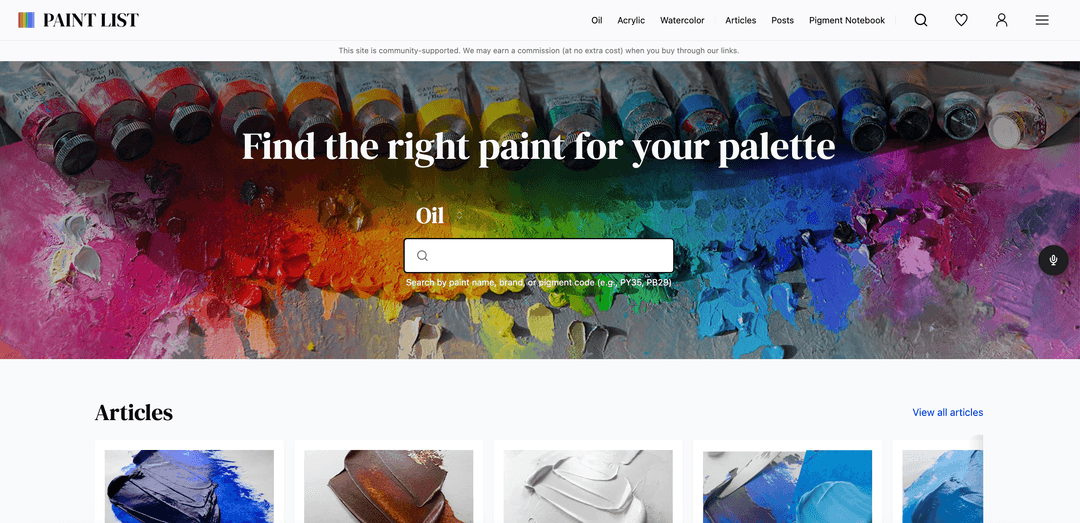
Search for paints from the home page. Just select your desired paint medium from the drop down above the search bar. In the search bar, enter a paint name, a brand, or a pigment code
Selecting a Medium
Oil, Acrylic, Watercolor and More
Here's a closeup of the search box. The drop-down will show the various mediums. On Paint List you can search for paints in oil, acrylic and watercolor, as well as some of the rarer mediums. You can find paints in Gouache, Water-Mixable Oil, Acrylic-Gouache/ Acryla Gouache, Alkyd, Casein, Encaustic, Egg Tempera, Oil Stick or Oil Bar, and even find Dry Pigments.
From there, you can type in a paint name, a brand, or a pigment code to search for paints.
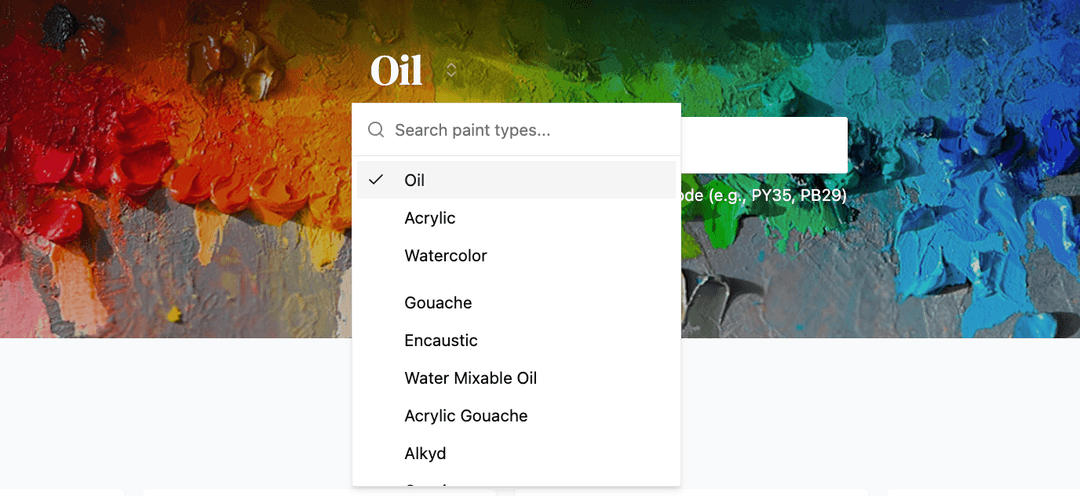
A closeup of the search function shows the various paint mediums you can search on Paint List
A basic search by Paint Name
Search for paints named Ultramarine Blue across brands
The most basic type of search is for a paint name to see some of the options across brands. This will work well for most paint names, but it is even more helpful to search by Pigment Code (a painter's secret superpower, described below).
By typing in the paint name, you can find other tubes with the same name (but not necessarily the same pigments).
The search results show paints named Ultramarine Blue from across multiple brands. By default, single-pigment paints are shown first. Each card represents a paint. Just as a side note, bear in mind that screen colors are approximate and may not represent the actual color of the paint. The colors on the paint cards are from the supplementary materials provided by paintmakers and art supply companies.
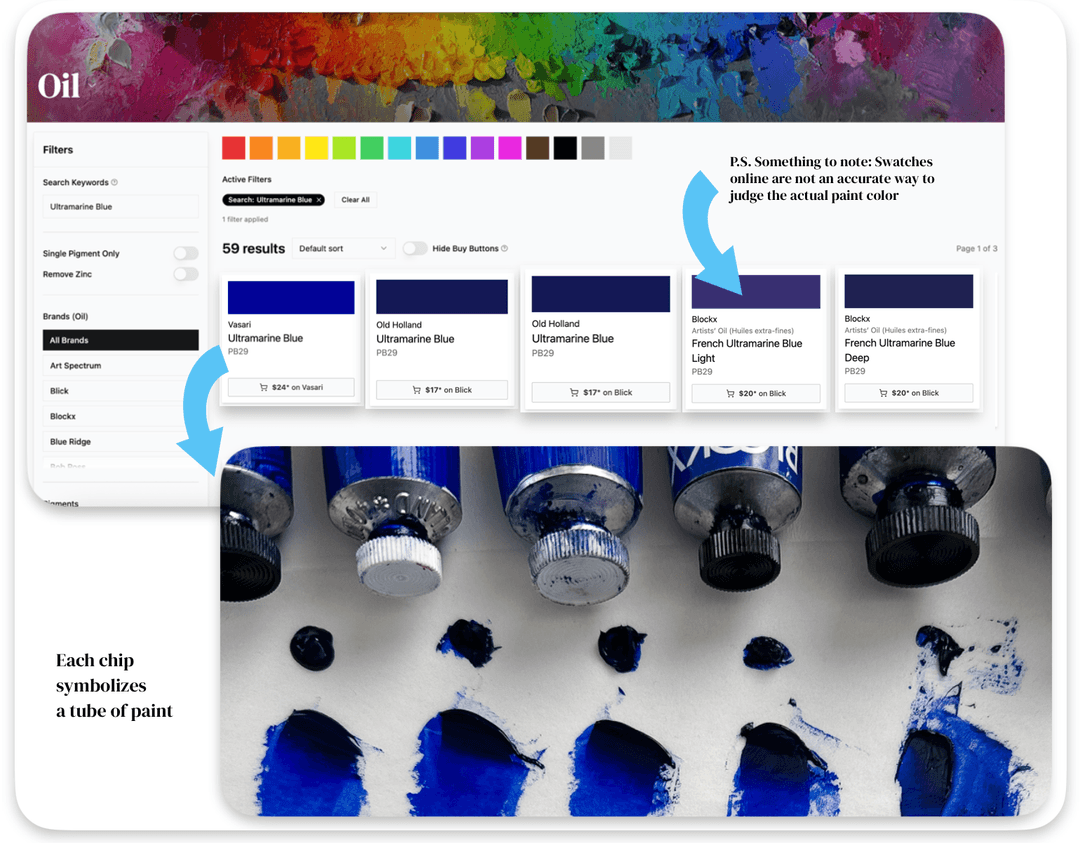
A search in oils for the paint name Ultramarine Blue. Each rectangle represents a tube of paint.
The Painter's Secret Superpower - Pigment Codes
The Most Powerful Way to Discover New Paints
Did you know that your paint tubes contain a powerful code? These are so useful to painters that we designed the Paint List to be able to look up paints by this code. Instead of looking at the front of the tube, look for this code on the back. Something called the Colour Index name, or pigment code, describes the substance that gives paint its color, and if you know how to find it, it can tell you
-How your paint will likely behave in color mixtures -Guidelines for its transparency -Toxicity -Probable lightfastness
It can a painter sort through many similar-looking paints to find higher quality pigments. It can also help clarify the jargon of many different paint names to understand what the colorant is inside.
The ability to cut through marketing names that are used to describe paints and get a clearer idea of what you are buying is hugely useful.
These codes are so powerful that they are the number one thing we look for on a tube of paint. On paint list, you can type the code (no spaces) into the search box, and surface the paints made with that pigment.
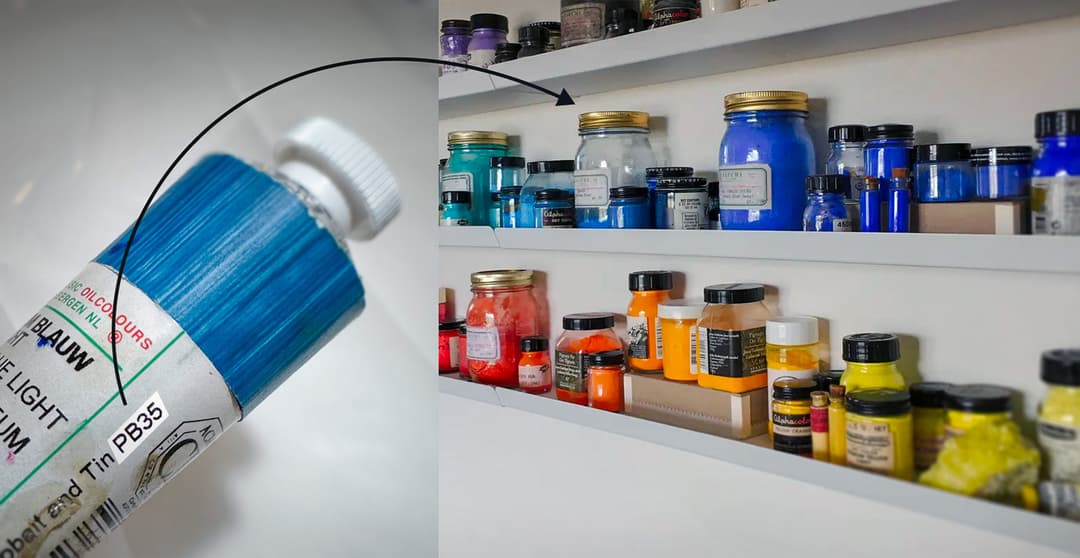
Pigment codes are a painter's secret superpower. The codes are usually located on the back of a tube of paint and describe the pigment that is used to give the paint its color. This paint tube is called Cerulean Blue Light, but there are a lot of different spellings of Cerulean, and perhaps the paint is listed in Dutch or English. However, the pigment code is PB35, which makes it easier to understand what is actually in the paint.
Paints are made of Pigment and Binder
While lots of mystery ingredients go into a paint, every painter needs to understand the pigment and the binder
Searching by Colour Index Name or Pigment Code (e.g. PB29) allows you to see all the paints with that color as well as the convenience blends regardless of what the paints were named. As a tip, we recommend omitting the spaces in the code (for example, type PB29 all together, without spaces).
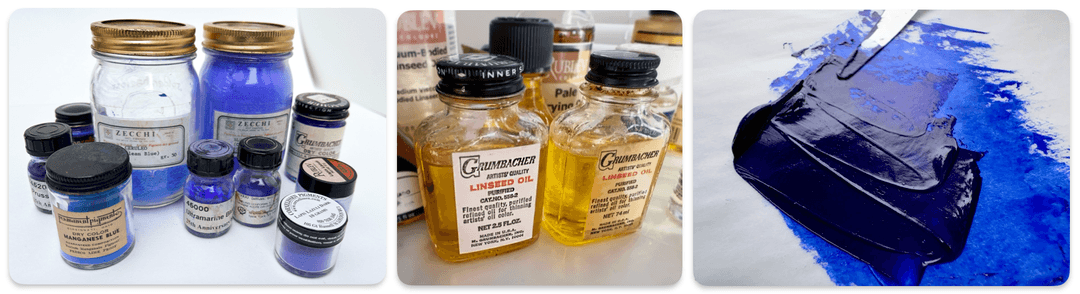
While paints may contain other things (like fillers, additives, or stabilizers) at their most simple, paint is made of pigment and a binder. On Paint List, you can search by pigment code to discover which paints are made with your favorite colors
We prefer to search for pigments because paint names may be all over the place. There are no official standards for naming paints, but there are standards for pigments. Pigments are serious business as they convey important information about the toxicity, lightfastness, and color capabilities of a paint.
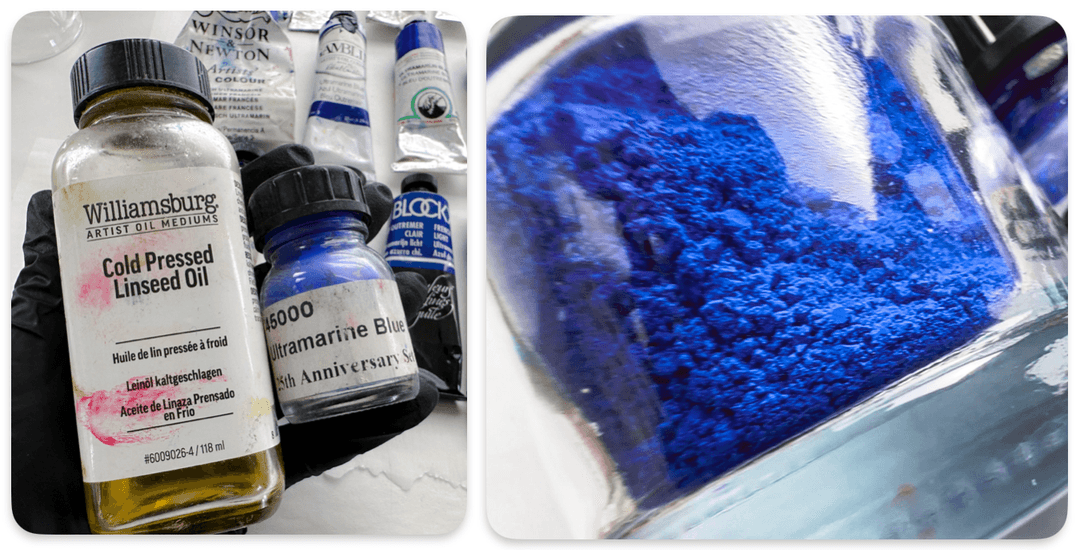
On the left, a simple pigment and binder duo, Cold Pressed Linseed Oil from Williamsburg and Ultramarine Blue pigment from Kremer Pigments. On the right, a closeup of Ultramarine Blue pigment, PB29, which gives ultramarine paint its gorgeous color
The Most Powerful Way to Search for Paints - Pigment Codes
Instead of looking at the front of a tube of paint, look at the back
Searching for paint by pigment codes opens up new opportunities for paint discovery. Every reputable paintmaker will publish the pigment codes for the paint on the back of the tube. This is extremely valuable information as there is a ton of information about each pigment code. We have shared excerpts from our own pigment research in the Pigment Notebook on Paint List.
Of the eight tubes matching the name Ultramarine Blue, a glance at the pigment code tells us some useful information. First, seven out of the eight are single-pigment colors. Second, there are no listed white pigments, so these are likely to be deep clear royal blue colors. Second, in the top row, the third tube from the left contains a blend of two pigments, Ultramarine Blue, PB29, and Ultramarine Violet, PV15, which is a related color that leans a bit more toward purple, so that one is likely going to be extra indigo-leaning. Last of all, Blockx has two different ultramarine blues with the same pigment code listed. These likely to be slightly different color variants of PB29.
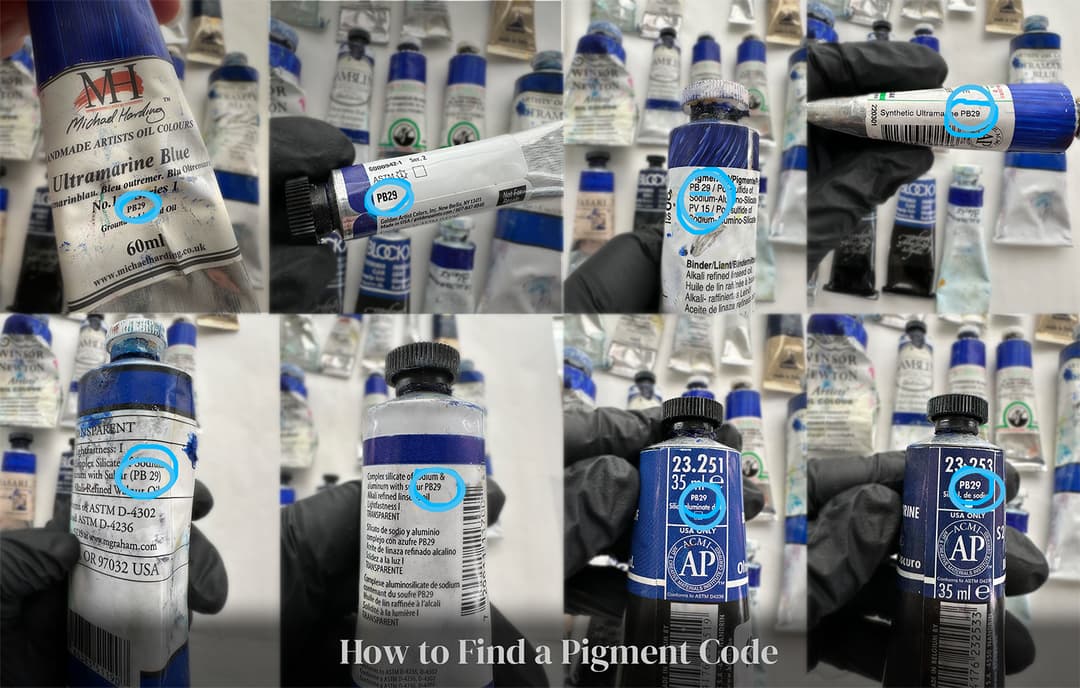
Where the pigment code is listed on eight different tubes of paint that contain the name Ultramarine Blue. Most, but not all, of the pigment codes are on the back. Each tube is marked with the code PB29, which is the code for Ultramarine Blue
Search for a Pigment Code on Paint List
Search results and filters on Paint List
Now we'll do a more dialed-in search for the pigment code for Ultramarine Blue, PB29. This will give us focus on those paints which are made with PB29, Ultramarine Blue pigment.
By default, in the results, single-pigment paints will show up first. There are a lot of blends that use PB29, but they will be found on the last pages of the search.
Searching by Pigment Code helps to uncover More Results Using the pigment code helps to cut across the paint names, so paints named Ultramarine Blue, or Ultramarine Blue Deep, or Ultramarine French, or even just Ultra Blue, will all come up in your search results. The search is less dependent on whatever a paintmaker chose to name their colors, and helps to discover new paints.
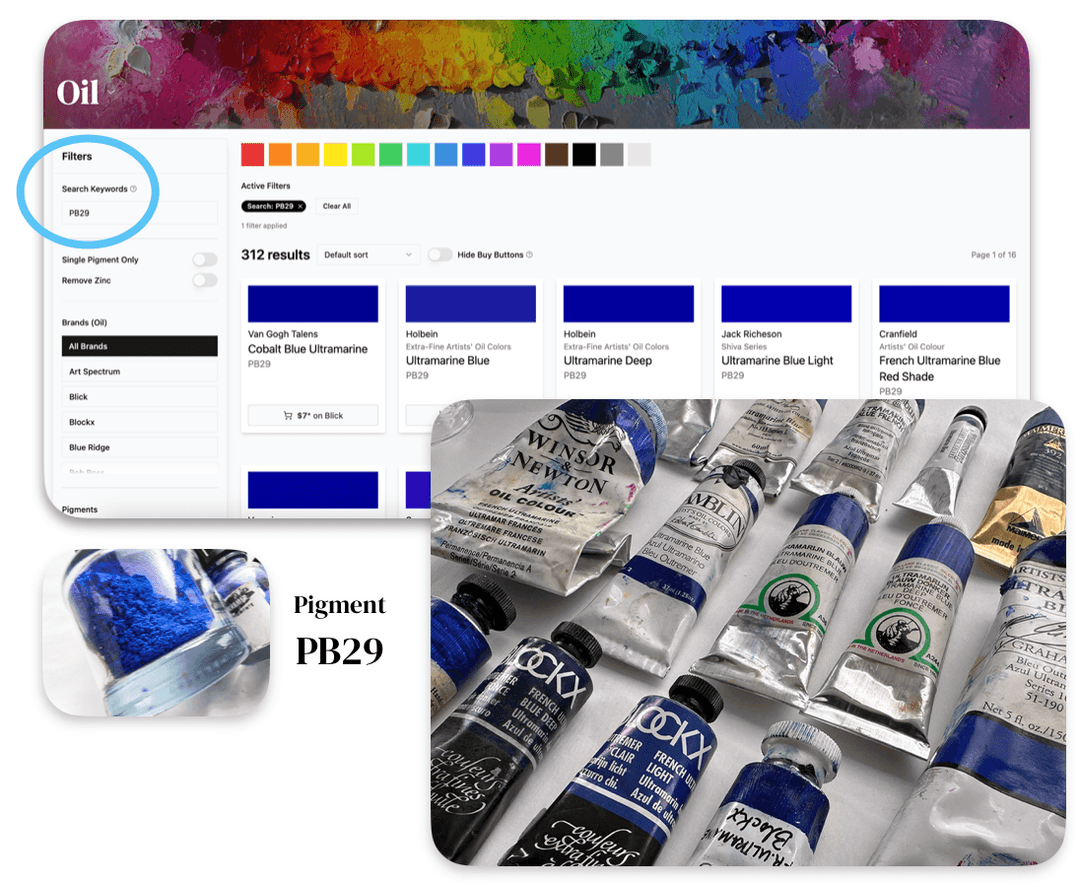
Search results on the Paint List for the search "PB29." Each rectangle represents a paint tube. The filtering options are on the left, and the active filters are displayed above the paint chips.
Exploring the Basic Search Filters
Filter by Brand
So, we have selected the paints that include pigment PB29, Ultramarine Blue across brands. Now lets say we just want to see which ones of those are made by Old Holland. On the left, select Old Holland from the search results.
This is super interesting--Old Holland makes not just one but three Ultramarine Blues. Two are single-pigment PB29 paints, and the third is a combination between Ultramarine Blue PB29 and Cobalt Blue. There are also a number of really interesting blends.
However, some of the blends contain zinc.
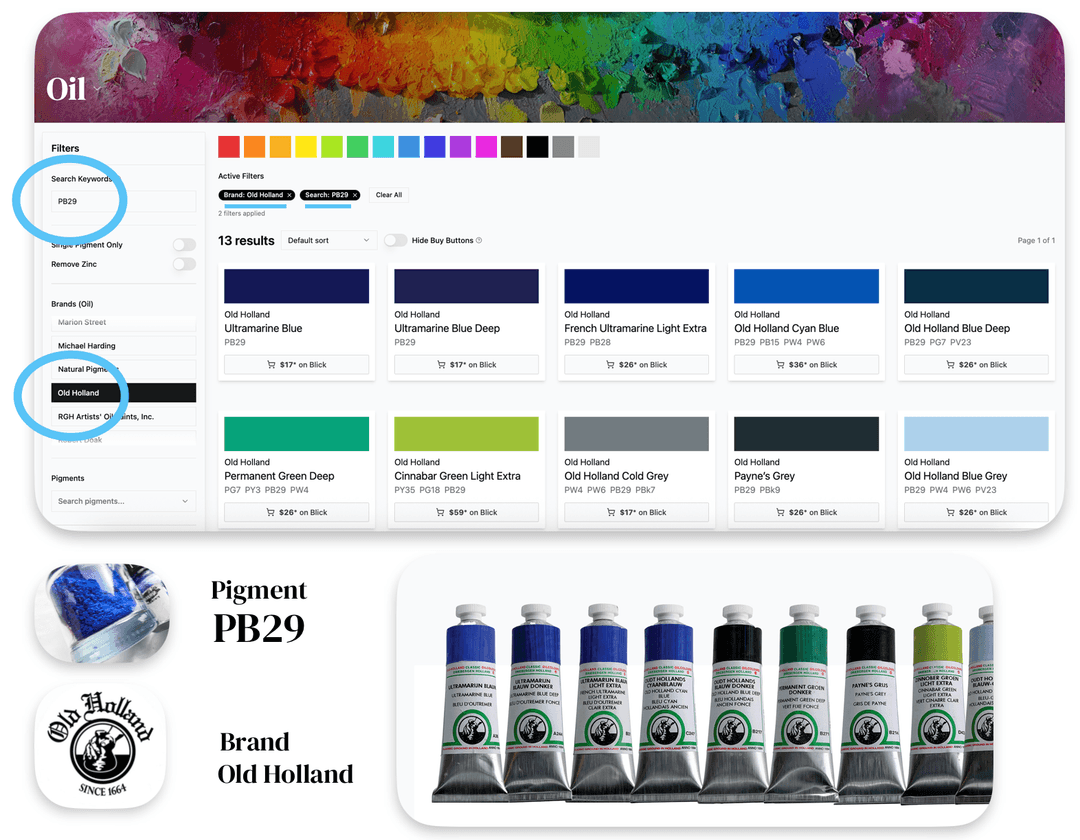
After searching for a term (we searched PB29, a pigment), one can filter by brand on the left. Here we selected Old Holland. This surfaces the Old Holland paints that are listed as containing PB29 either as a single pigment or as part of a blend
Removing Zinc from Search Results
A particular feature for oil painters
Some painters may wish to remove Zinc White, PW4. To learn more, check out the Pigment Notebook. Zinc Oxide has been linked to early embrittlement and even delamination in oil painting, but other painters seem to have used the pigment without experiencing these effects. The exact amounts which are thought to be safe have not been conclusively established. Zinc White has some nice immediate benefits on paint blends as well as some desirable qualities in Titanium White blends. Some brands have left zinc in their formulas, which is a bit troublesome to those of us who wish to avoid it.
So, we built a filter to help remove paints that list zinc white, PW4, among the pigments. Also, we've heard rumors that some brands do use zinc and don't list it, which isn't good. So the filter on Paint List does rely on whether it's listed. It's not perfect (there is always the possibility of human error as well) so we always double checking with the manufacturer and retailer for anything of importance. However it is a super handy way to narrow down search results to paints that do not list zinc.
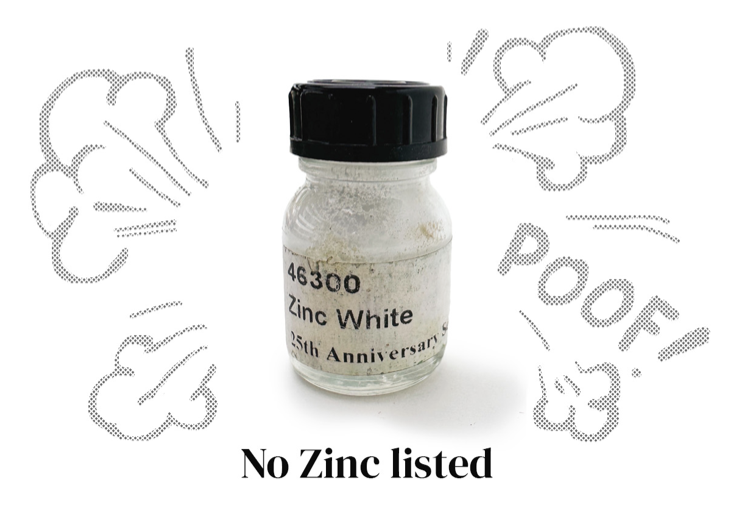
A problematic pigment in oils, Zinc White, PW4. When searching oil paints on Paint List, you can opt to remove paints that list Zinc Oxide among the pigments
The Remove-Zinc Switch
A handy way to pare down search results
Let's say that you're like us and don't wish to have zinc white in your paints. There are some companies that don't disclose the zinc (which is really problematic!) as well as ye olde human error (it's possible we could miss one - so do read the pigments), it's really handy.
So, while you'll still need to double-check the results and apply both research and common sense, this toggle will help to quickly remove results that list Zinc Oxide and help to highlight paints that do not have PW4 among their pigments.
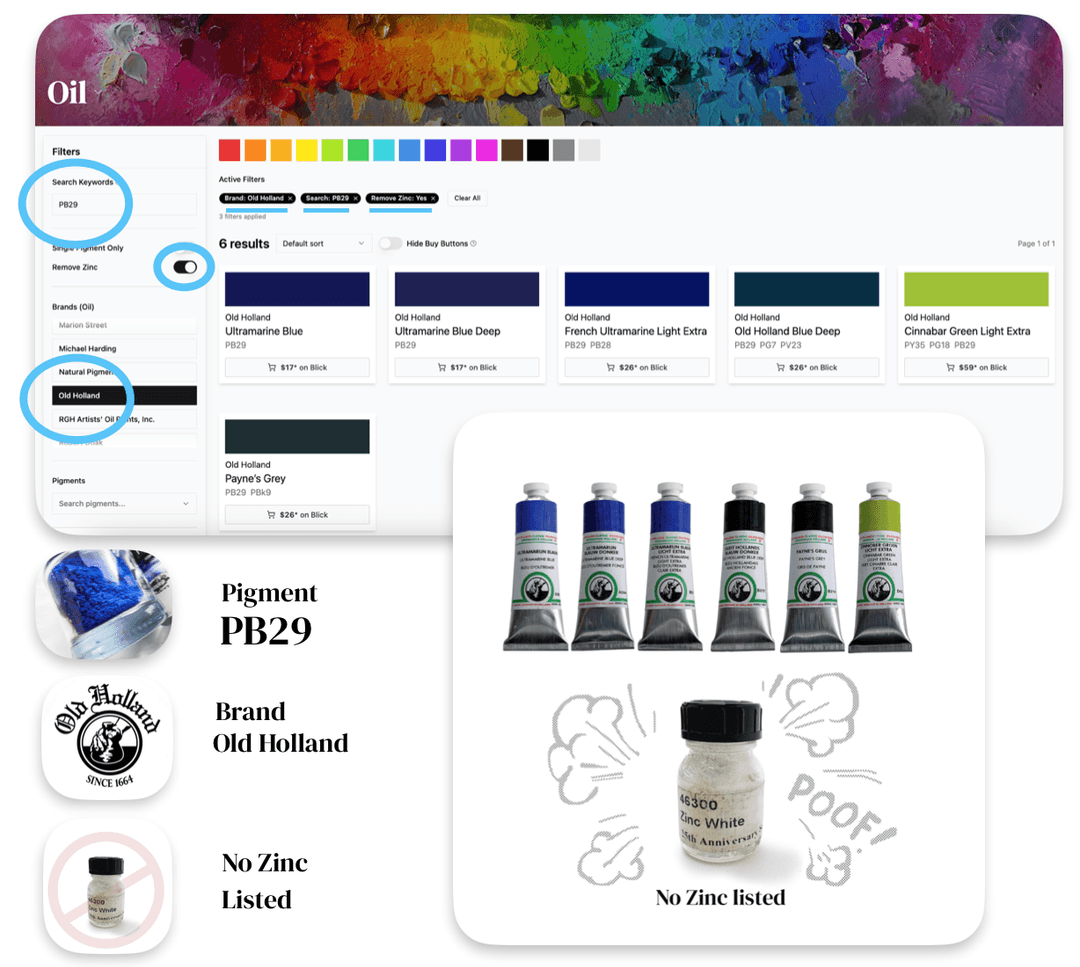
A toggle switch on the upper left of the filters is a fast way to remove results that list Zinc Oxide, PW4. This leaves paints that have the pigment PB29, the brand Old Holland, and those which do not contain PW4 as a listed pigment
The Single-Pigment Filter
This is one of our favorite filters, and yes, we could have turned it on first, but then we wouldn't have been able to demonstrate the remove-zinc filter as many of the paints that contain zinc are blends. The single-pigment filter shows paint brands that have the pigments listed, and only list one pigment.
Single pigments are really helpful for building limited palettes used by professional painters. While convenience blends have a special place in our hearts, the core of our palettes is built with high-quality single-pigment paints.
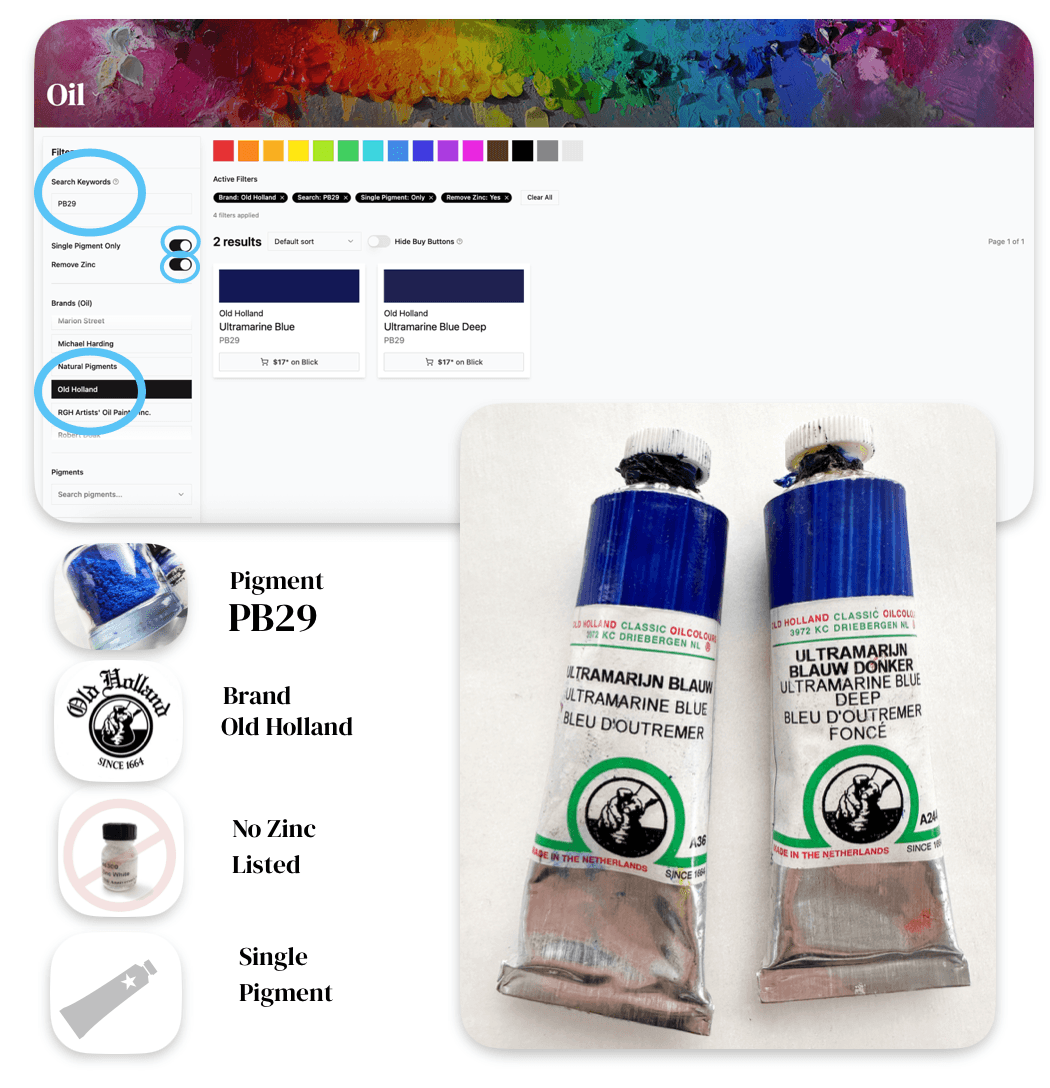
Some single-pigment paints. The criteria here are that they must be made of PB29 (the code for Ultramarine Blue Pigment), match the brand Old Holland, do not list Zinc Oxide PW4, and are listed as a Single-Pigment. We could have turned this switch on first, but it's interesting to see how the results dramatically zero-in. Single-Pigment paints are recommended for building powerful limited palettes.
Getting to know the Paint Cards
Brands, Paint Names, and Pigment information at a Glance
When you search paints, the results are shown as Paint Cards.
This paint card shows key information at a glance like the brand, (e.g. Winsor and Newton) and sub-brand/paint line (for example, Winton vs. Artists' Oil Colours), the pigments, and a digital color swatch. Please note: the digital swatch is not representative of the paint.
As a note on the digital color swatches, unfortunately, it's impossible to portray the colors completely accurately for a number of reasons. First, paint is a material. It may look totally different when thinned vs. in masstone (think here Phthalos). Second, several important colors are out of gamut (here we have the cadmium yellow lights, ultramarine, and the blue-greens). Third, every display is different. So even when we color correct something it will look different from one screen to another.
The color swatches are not a reliable indicator of a paint's color. This lack of color correspondence is true for many reasons that go beyond the scope of this quick start guide. For now, don't trust the digital swatch (or any other online color approximations of paints for that matter)!
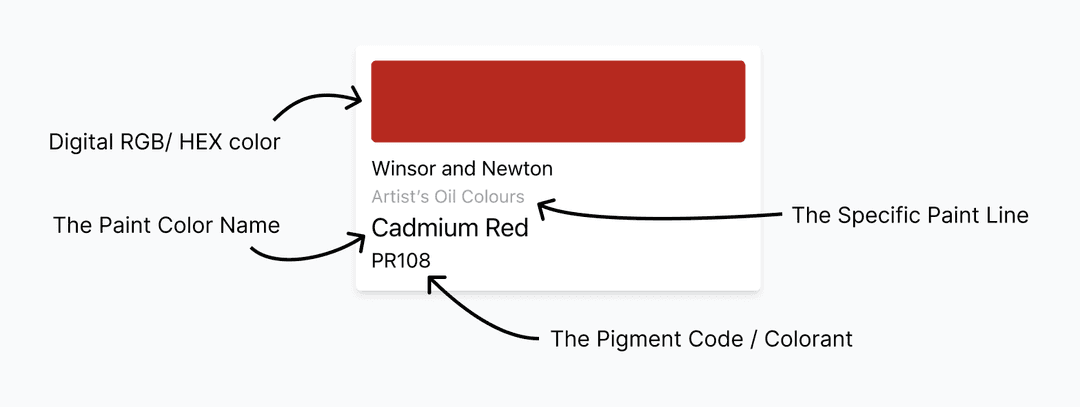
A paint card shows a swatch (but this is not usually a great representation of the color). It also has the brand name, the sub-brand or line of paints to which the color belongs, the Paint Color name, as well as the pigment code.
Each Individual Paint Has Its Own Paint Page
Many paint pages are filled with information about a given paint. A page may have pictures, a review, and shopping links. Some links are affiliate links - that means we may get a commission at no expense to the purchaser. Paint pages often include important information about the paint from the manufacturer, such as lightfastness or transparency. Also, if you're logged in, you can also see related paints at the bottom of the page.
Each paint has its own dedicated page filled with information about it. This information comes from manufacturers and retailers, and we are always adding more. We try to find information from the brand on lightfastness, pigment composition, binder, and opacity.
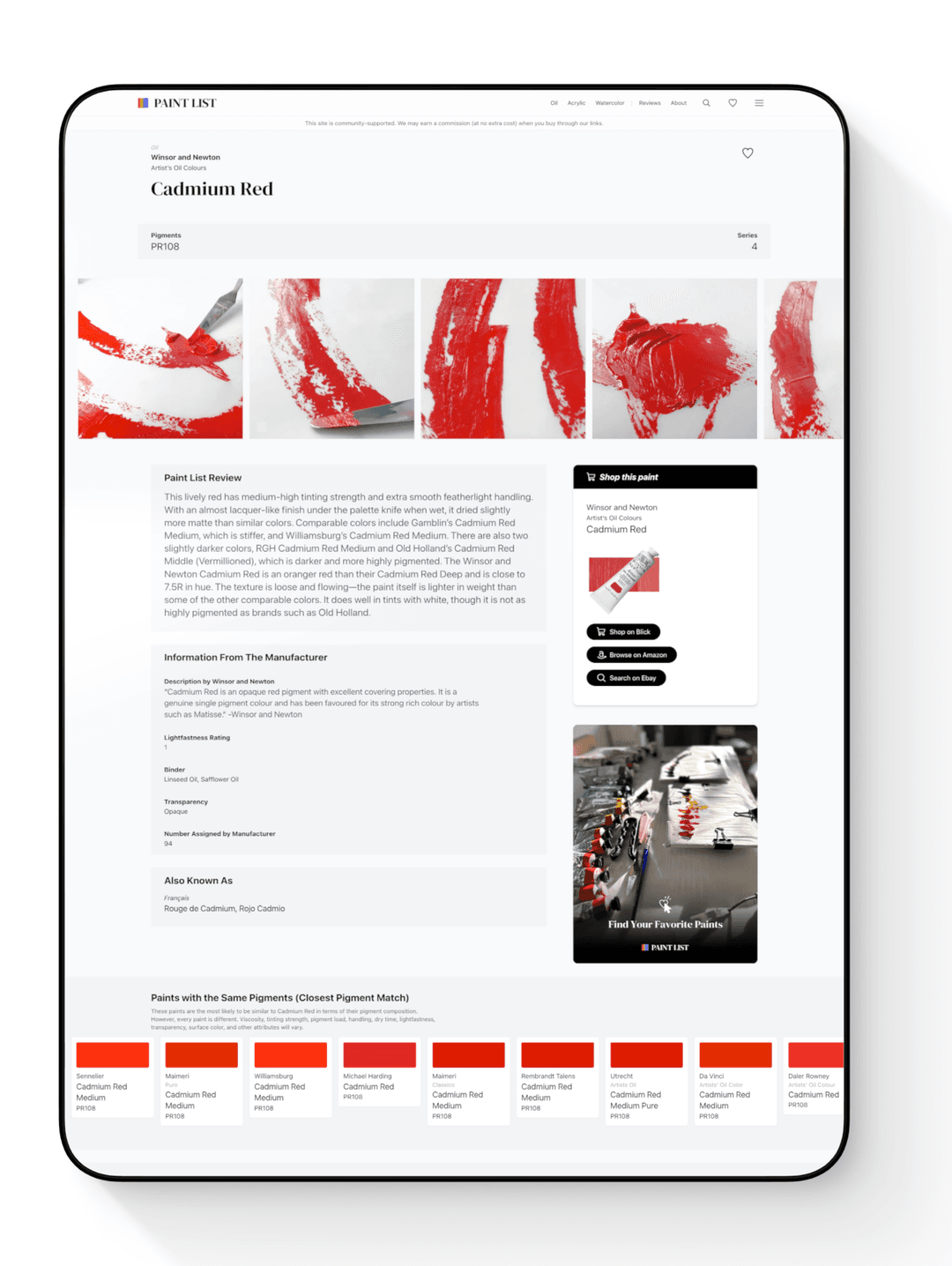
A sample view of a paint page with photos, a review, as well as information from the manufacturer. To view related paints, create a free account using the icon that looks like a person at the top right of the header.
The Paint Page
History, details, reviews, and how to find it
Have you ever had a favorite paint get discontinued, only to completely disappear from Blick and Jerry's without a trace? We hate it when that happens, and it was that experience that inspired us to make a place for every paint, regardless of its economic viability. As painters, we form relationships with our paints-- after all, they are with us every day in the studio. We get to know them. So, whether a paint is current or historical, our mission is to give every paint a place to live on the internet.
The pages are a constant work-in-progress. For some we have photos, reviews, and robust information. Other pages are waiting for more. Either way we will post information from the manufacturer and resources on where to begin looking if you'd like to acquire that particular color.
Also, every paint page has a heart at the top right where you can save that paint to your paintbox.
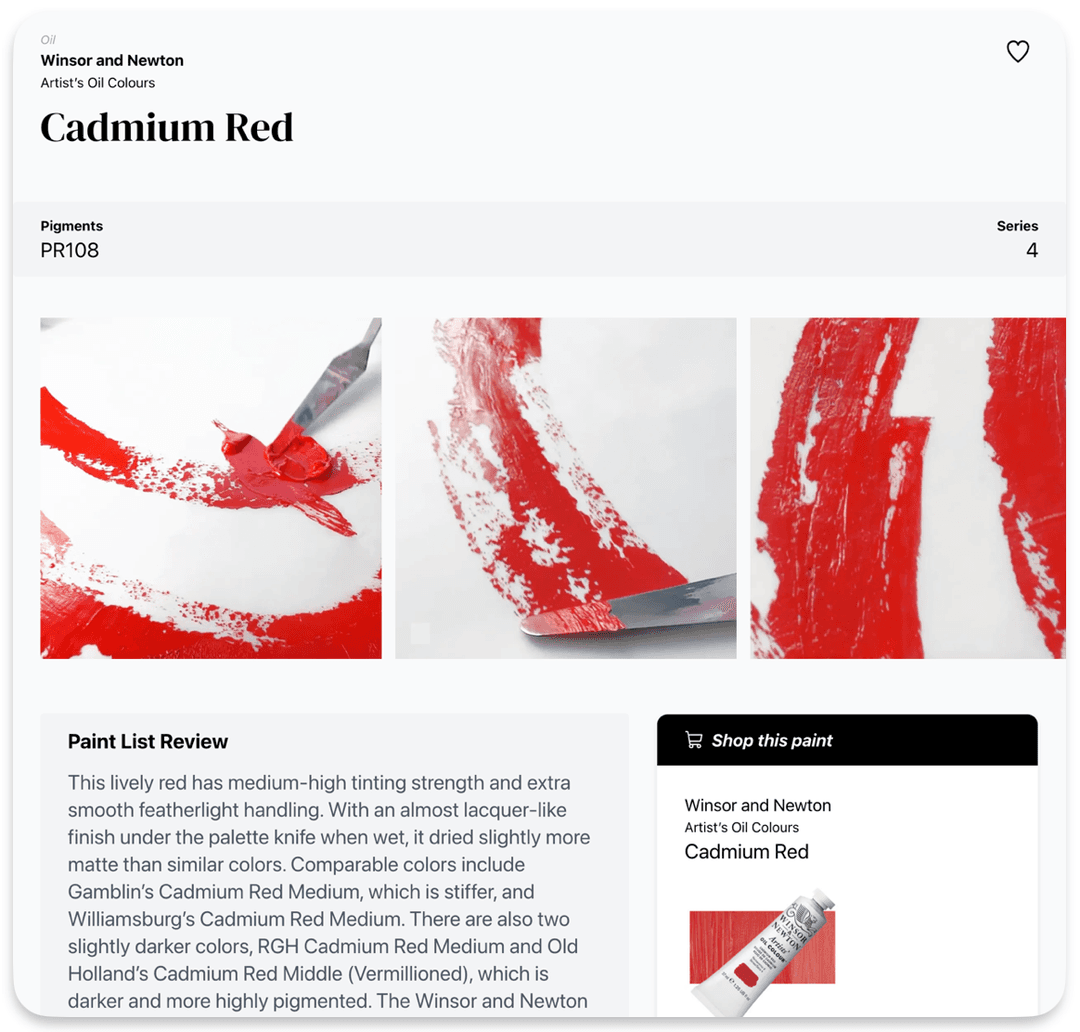
Deep Dive on the Paint Page
For the curious, here is a deeper dive on what can be found on some of the paint pages
Paint List Reviews If you see a robust review with comments about how the paint handles, that means it's a paint we've purchased ourselves. Sometimes you may also find general comments here that are much more broad in nature.
Description by the Brand We also include what the brand has to say about themselves in their marketing materials because sometimes this helps painters to learn more about a particular line of colors. We may also have general information based on what's been provided by the paintmaker.
By the way, if you find any mistakes please let us know. The information here, just like the rest of the Paint Page, is based on the best information we have at the time.
.png&w=1080&q=75)
An explanation of the various pieces of the paint page
Information from the Manufacturer
Lightfastness Rating
This is information from the brand, and it varies a lot. Basically lightfastness describes how well the paint is expected to hold up to light exposure over time. However, this may be a less reliable rating than once was thought.
A whole new lightfastness standard is being proposed because it turns out that lightfastness may have some complexity to it. Depending which mixing white is used, the lightfastness of certain pigments in oils appears to vary.
One of the reasons we made Paint List is to raise awareness of this issue for painters. More on this elsewhere on the site, but just know that the very best measure of lightfastness are the tests you do yourself.
Brand lightfastness schemas differ (sometimes a 1 is high, sometimes it's low) and so in the future we will be adding some additional information explaining each schema. ASTM I is considered excellent, however that is still a fairly wide category.
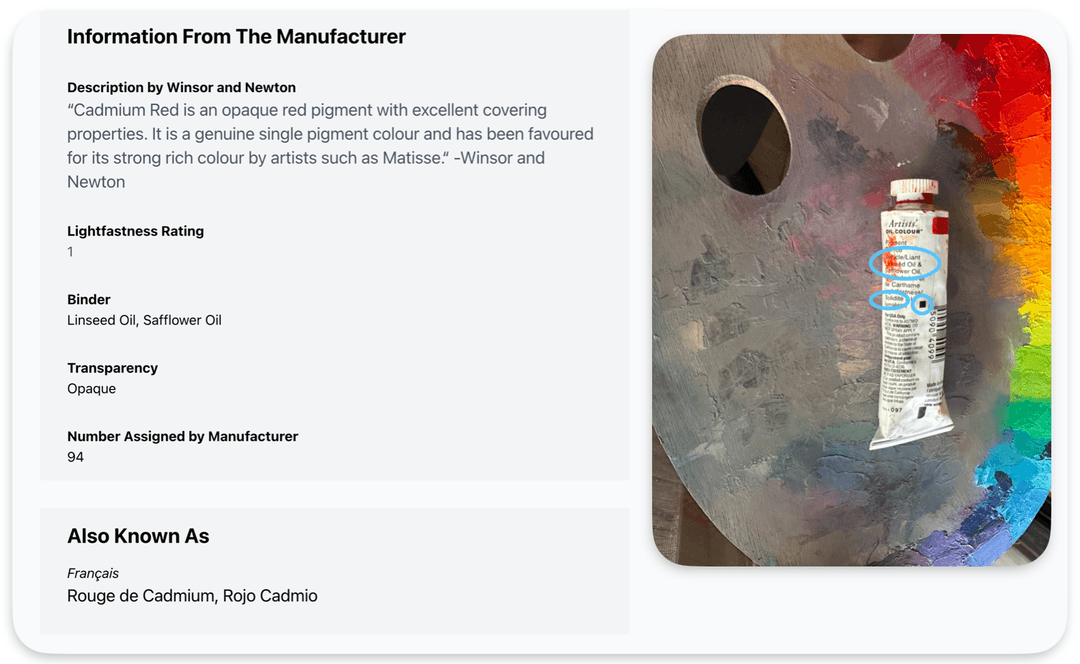
Some of the information from the Manufacturer may be listed on their paint tubes, other times it can be found in a brochure that they publish about their materials. This tube lists the lightfastness (Lumiere I), the binding oils, and a symbol for the opacity. We have collected this information so that it can be taken in at a glance
Binders
The choice of binder matters a lot in oil paint, and so if the manufacturer has provided this information we like to include it. There are important differences between the way the various drying oils behave which may have consequences for the way a painting dries (or doesn't)! So be sure to research the various oils. Other factors may also influence a paint film.
Transparency This is information provided by the brand, and the assessment of transparency vs. opacity can vary a lot.
Number Provided by the Manufacturer This is an important number that can really help to pinpoint a specific paint. Sometimes this will be something like "Rose Madder #354." This is different than the pigment code. The manufacturing number is unique to the way the brand names their colors, and it can be considered a supplement to the paint name. The number "354" can really help to be sure you have the right tube. It's an extra identifying feature that's unique to a paint line.
Other Information Sometimes brands are really robust with the information they provide and they will include categories like oil content or particle size (for watercolor we have granulation and staining).
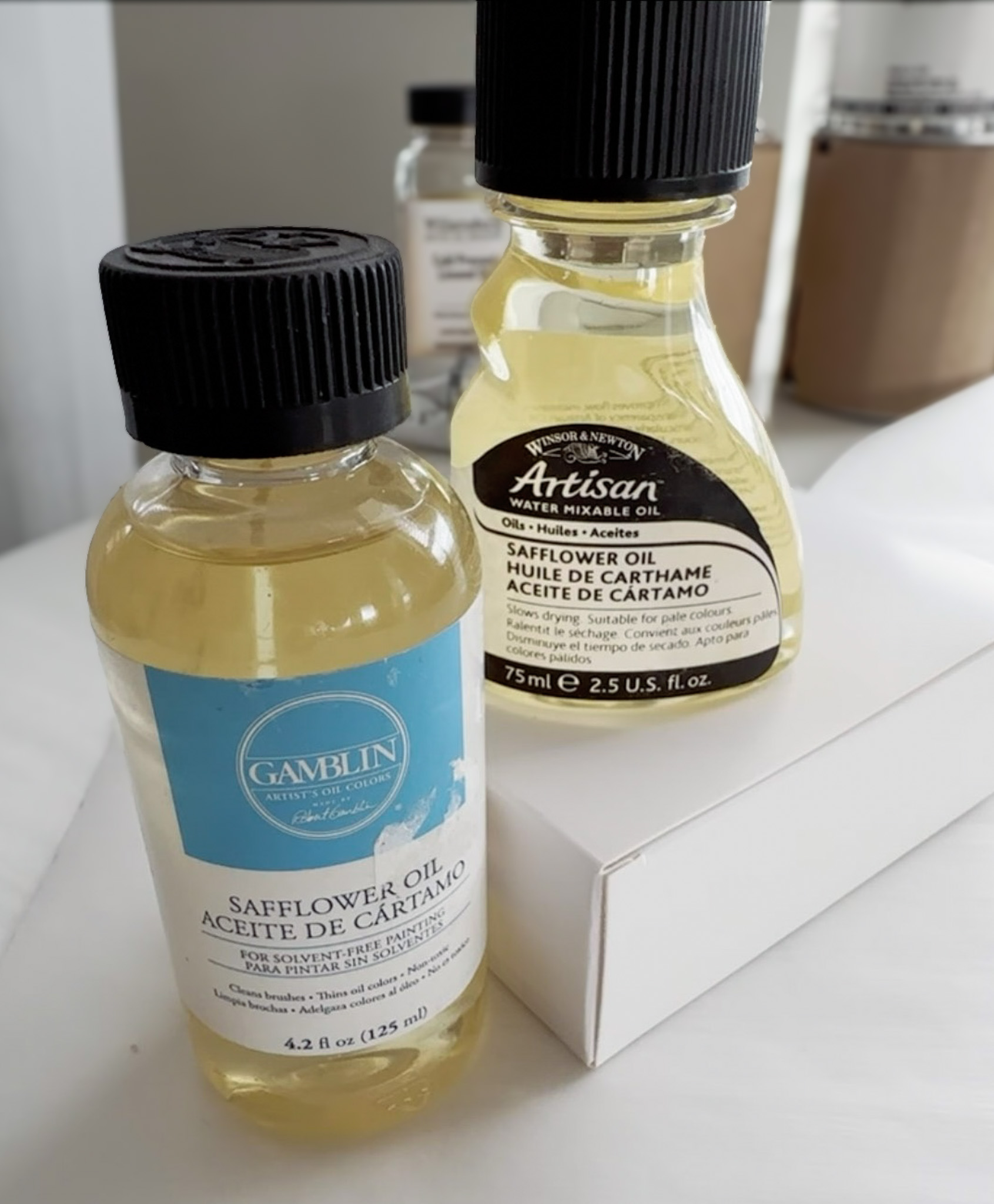
Safflower oil is one of the binders sometimes found in artist oil paints. Some painters wish to avoid safflower oil for various reasons, so we made a way to filter by binding medium on the Paint List Search
Videos for Paints
Be sure to check out our YouTube channel for videos of the paints
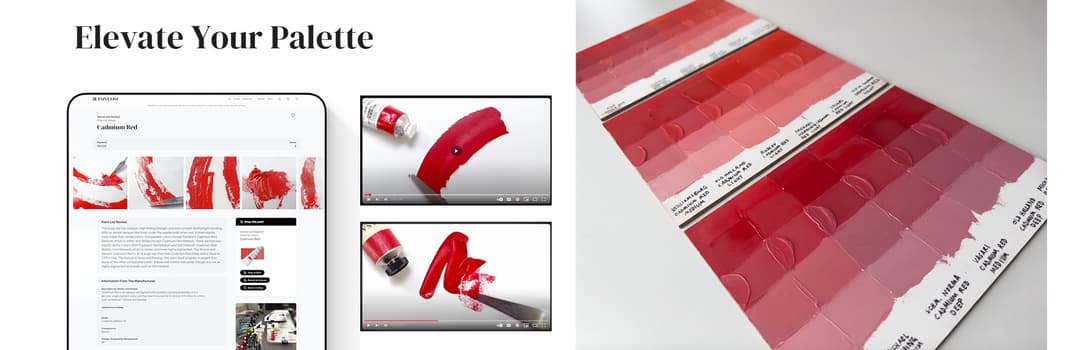
For some paints, we have videos that feature that specific tube or color. Be sure to check out our YouTube channel @thepaintlist for cross-brand reviews and spotlights on certain paint colors.
We also keep our eyes open for videos made about a certain color, and if a manufacturer has a video specifically tailored to a given color we may feature it on the Paint Page. If there is a video associated with a color, you'll find the video at the bottom of the page.
Exploring Cross-Brand Reviews
One of our favorite things on Paint List
The heart and soul of Paint List is the cross-brand review.
If we've written about a given paint in a review on the site, there may be a linked review here. In cross-brand reviews, we compare colors to very similar colors across brands and share detailed notes on how these paints compare with one another.
How Paint List Stays Independent
Our reviews are totally independent.
We believe in independent testing, which means that we do not receive free paint in exchange for reviews. Some of the links on the Paint List are affiliate links but not all of them are. Also, at the time of this writing, we do not partner directly with any manufacturers, even the small ones. (We will update our affiliate information if we partner with any small manufacturers in the future). Instead, we partner with retailers which sell many brands, so we may make a commission regardless of which brand a paint a person buys, at no extra cost to the purchaser.
How the Affiliate Link Works
The link is time-related, so for something like 24 hours, when a person buys something after clicking through on one of our links, it is possible that we may make a commission from the retailer. In other words, the purchase has to be made within a time frame for us to potentially receive a commission from it. This is at no extra cost to the buyer.
How We Make an Artist-Supported Community
This structure allows for an artist-supported community and also allows us to make the Paint List free for everyone, regardless of whether they buy paint through our links.
We support small manufacturers whether they have an affiliate program or not, because we love high quality boutique paints.
Check out our article section to see extensive reviews and cross-brand paint comparisons.
We are always adding more reviews, so be sure to sign up for our newsletter (at the bottom of this page) to be the first to know when a new review arrives.
%2F211-03%2520Cadmium%2520Red%2520Deep%2520PR108%2C%2520Oil%2520Paint%2520Brand%2520Comparison%2520on%2520the%2520Paint%2520List%2520of%2520Old%2520Holland%2C%2520Michael%2520Harding%2C%2520Schmincke%2520Norma%2C%2520Vasari.jpg&w=1080&q=75)
A cross-brand review of Cadmium Red paints. Our articles compare the similarities and differences across brands.
A Key to the Cross-Brand Review: the Oil Paint Review Legend
A brief overview of how the panels work
In our reviews you'll often see the same arrangements of test swatches. To make these reviews, we've selected paints that we've purchased and used ourselves. We've selected a handful of colors which all have similar names or similar pigments. Here's a brief tour showing how the panels are arranged.
At the top is row 1: This area shows what the paint looks like thinned.
Since we operate a solvent-free studio, we show what the paint looks like when it's been diluted with a bit of Rublev Oleogel. We find this to be a great way to show the glazing properties of a paint as it just loosens up the paint in masstone a bit.
Row 2 from the top: This shows the paint in masstone at full strength.
The paint has been applied with a palette knife on panel.
Row 3: This section is an exploration of a paint's tinting strength. The semi-circle area shows the color mixed 50/50 with Titanium White. This is the "C" shaped area. For consistency, we use the same white for all of our mixes- Williamsburg's Titanium White PW6 in Linseed Oil.
The rest of the panel explores properties of hue and color character when mixed with Titanium White. The rest of row 2 explores what the color looks like with just a bit of white- with varying amounts in each column to reach roughly similar values. The quantity/ratio of color to white needed to achieve a somewhat visually similar value varies, however here were are exploring undertone. Rows 3-5 explore this with greater additions of white.
Rows 3 and 4: Comparisons and hue exploration
Rows three and four continue the more subjective task of exploring undertone in the paint. Again, the ratios needed of color to white will vary to achieve somewhat similar results.
There are limitations in what can be conveyed through a monitor as the issues of color processing will vary from screen to screen and device to device. For this reason we often provide the nearest Munsell readings for the colors given by a spectrophotometer.
The swatches are painted on Ampersand Gessobord.
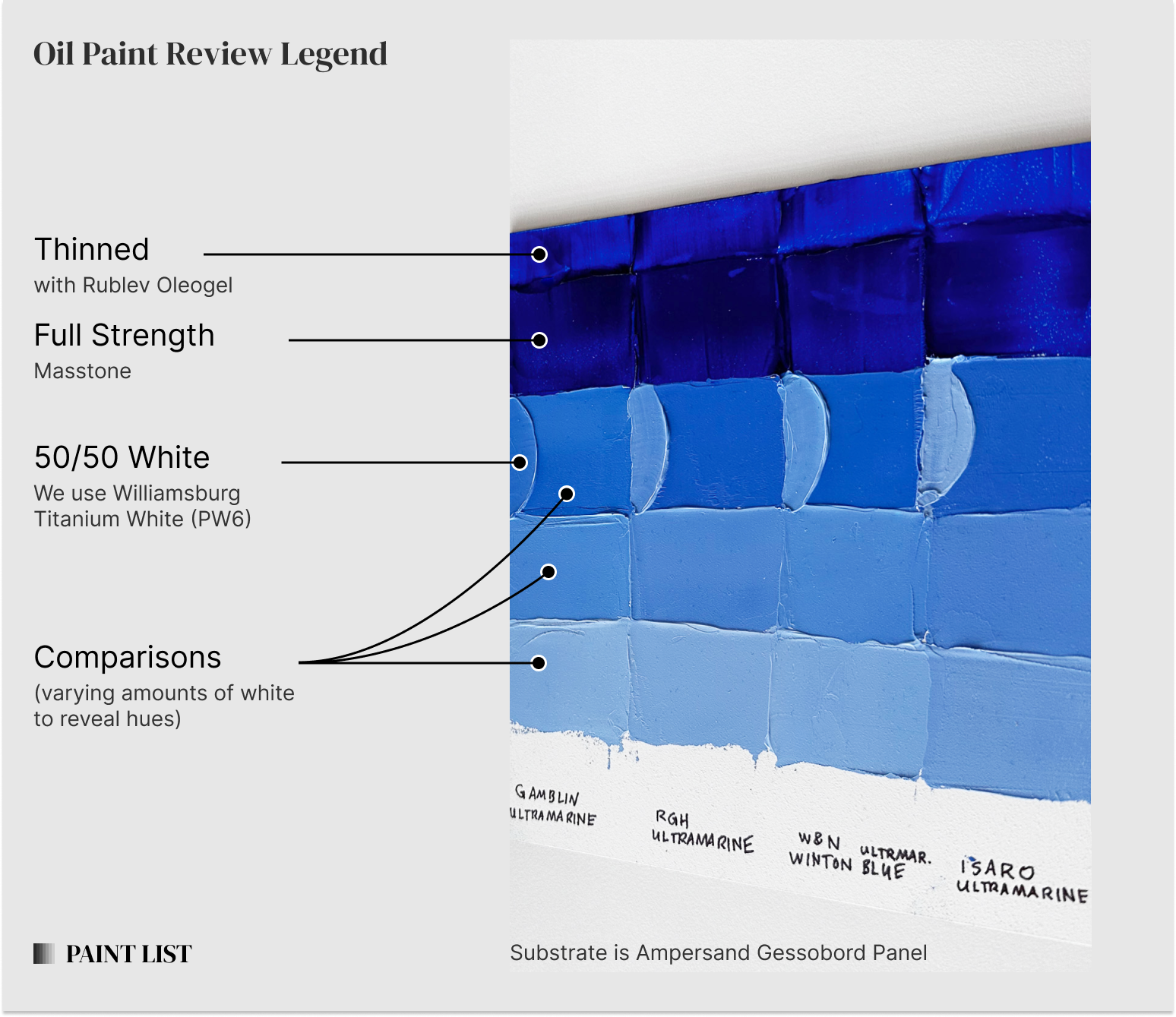
A key to explore the cross-brand comparison panels. The tinting strength is shown in the "C" shape swatches on Row 3. Color leanings when mixed with white (or what one might think of as an undertone) are revealed by mixing various ratios of colors with white to achieve roughly similar values in the other rows on the panel.
A Few Paints In Oil to Explore
Check out some paints to get started
Sign Up for our Newsletter
New Articles and Painting Insights
The best way to find out about new articles from the Paint List is to sign up for our Newsletter.
We send out news we find interesting in the painting world (such as pigment discontinuations), and share new videos and review articles.
Thanks for reading and Happy Painting!
