

Top Pigment
Green Earth, Terre Verte
PG23
Alternate Name
Terre Verte
Pigment Description
This is an increasingly hard-to-find color, which was historically used in verdaccio and underpainting for flesh tones. It is usually a gentle, lower chroma transparent green. Usually it is glauconite but can also be celadonite or other minerals. Unfortunately, many companies opt for blends of yellow iron oxide and phthalo green. We have it on good authority that every- or nearly every- PG23 out there commercially has a little tiny bit of phthalo green in it. Even so, genuine green earth has a very mild quality to it. Some also have larger particle sizes, so be aware of that. We find that to be a feature, but some people require very smooth paints (for example, if you use a glass palette this could be a frustrating quality). Some of the more interesting green earths are found from Williamsburg and Rublev.
This pigment is requires a high amount of oil to make it into a paint, and tends to be a slower drier.
In her work on artist pigments, Monona Rossol writes that some forms of celadonite have structure form similar to cancer-causing minerals, so while PG23 is not labeled for that hazard, please do your research when working with this pigment.
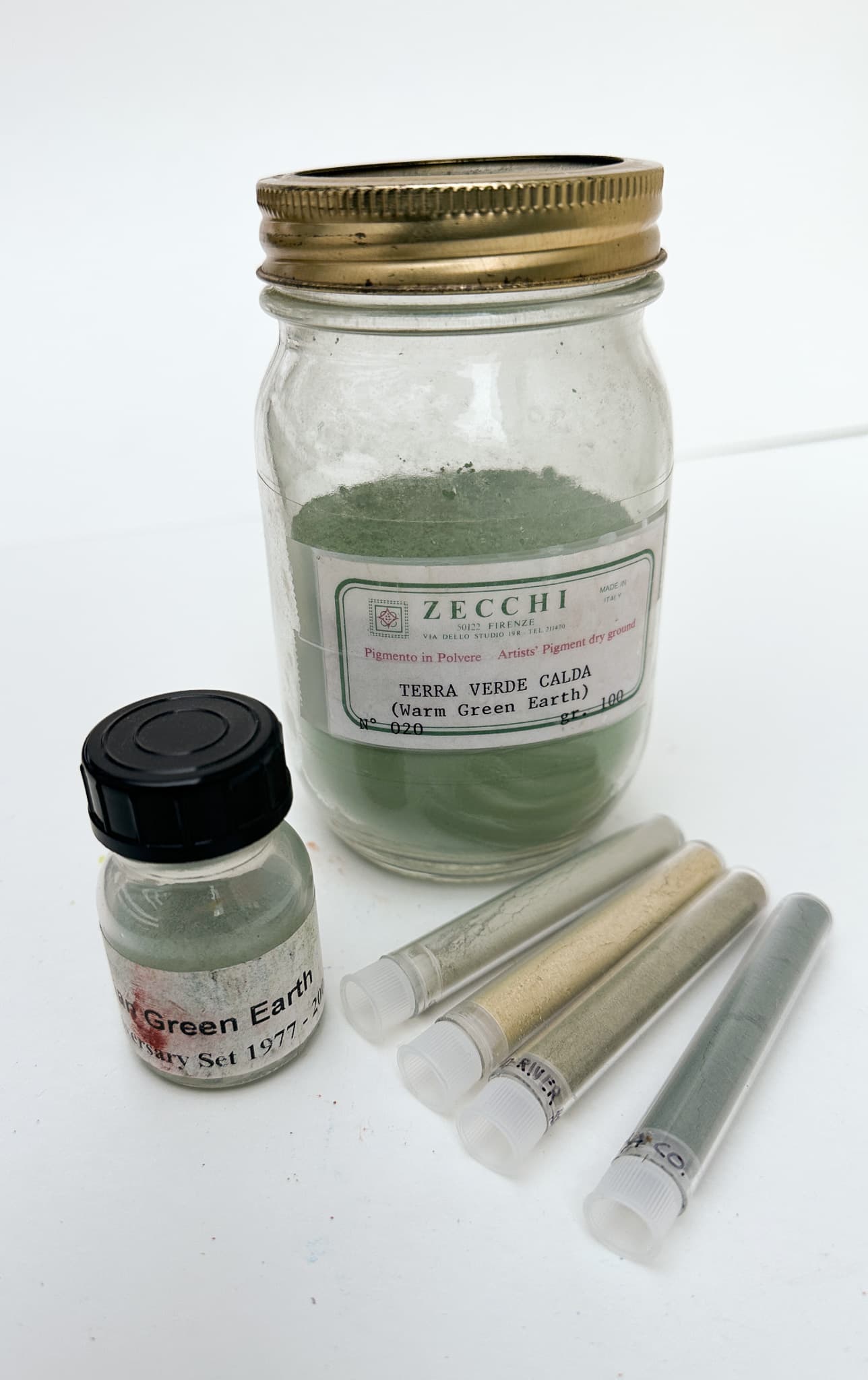
Samples of Green earth. On the left, Green Earth by Kremer pigments, center Terra Verde Calda by Zecchi, and foreground samples of naturally occurring Green Earth
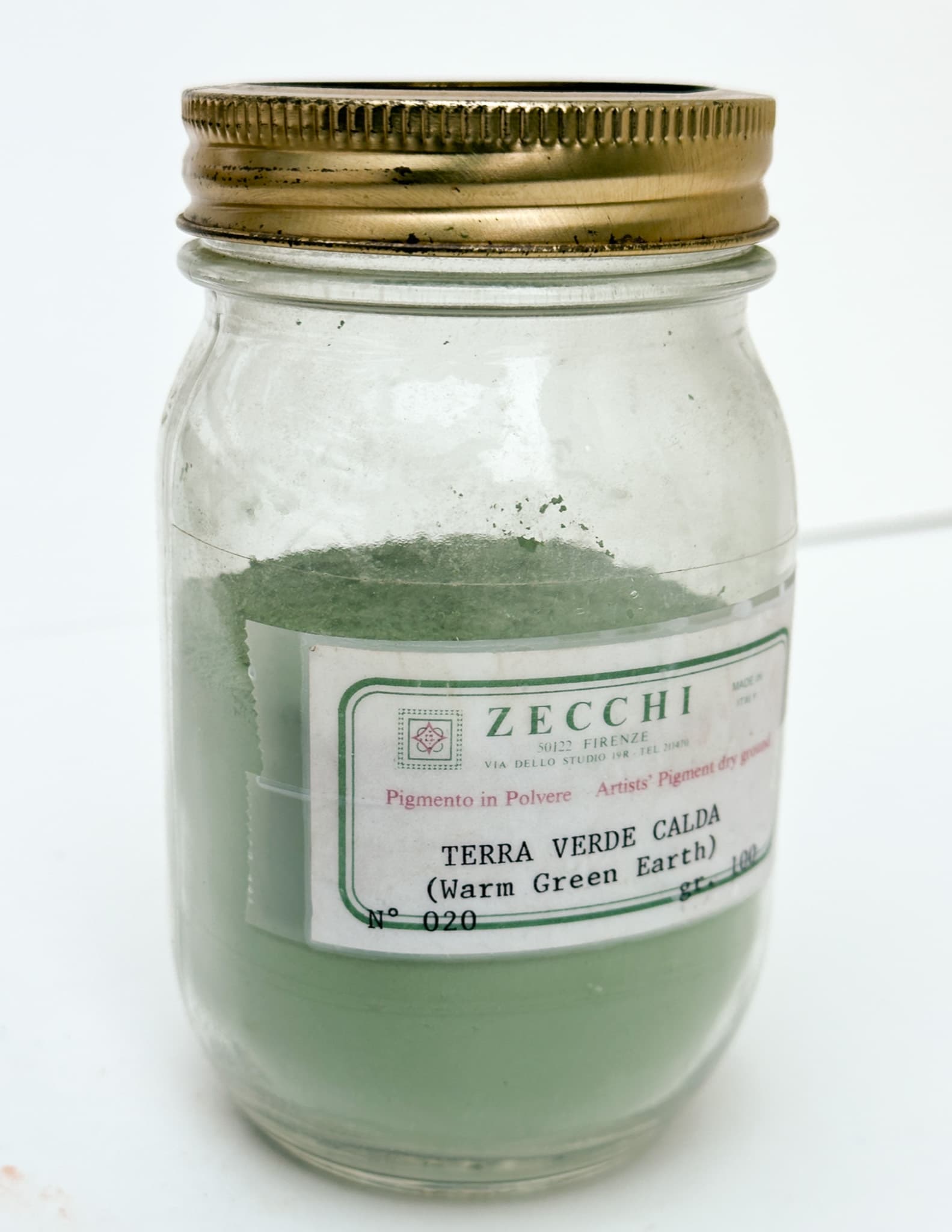
Zecchi Terra Verde Calda Green Earth, PG23 dry pigment
Resources
PG23 pigment data from David G. Myers, The Color of Art Pigment Database, Artiscreation.com,
Elliott, Virgil. Traditional Oil Painting. Echo Point Books & Media, LLC, 2019. https://amzn.to/4nwIdzq,
Information about PG23 from Bruce MacEvoy, Handprint Guide to Watercolors,
Rossol, Monona. The Artist's Complete Health and Safety Guide. New York, NY : Allworth Press, 2001. The book is rather dated, updated information is available from her website.
Stats
Lightfastness
Excellent
Generally considered to be among the most lightfast pigments, ASTM I. This particular pigment was not mentioned in Golden’s recent testing with mixing whites, so it may be useful to compare with other earth tones, which tended to be excellent.
Transparency
Transparent
Ranges from Transparent to Opaque in oils depending on the formulation. Most often found as transparent
Toxicity
Previously thought to be Lower Concern, however dust may a hazard
All pigment dust should be avoided, but specifically in regard to PG23, Monona Rossol mentions, “Some forms of celedonite are in needle/fibrous form similar to minerals that cause cancer.” Her work is available through her site.
Tinting
Low
Dry Time
Fast to Medium
Often listed as less than 5 days. Some list 1-2 days, may contain driers.
Oil Content
Medium to high
High by oil volume
Particle Size
Can be quite coarse
Chemical Name
complex aluminosilicate minerals, natural ferrous silicate with magnesium and aluminum potassium silicates
K[(Al,FeIII),(FeII,Mg](AlSi₃,Si₄)O₁₀(OH)₂ (source WebExhibits)
DISCLAIMER: Please note that we are not experts in health and safety and we are not toxicologists, please consult the proper experts. We are not liable for any issues that may arise from the use of our website or its contents. The information contained in this site is provided without warranty or guarantee of any kind. We do not necessarily endorse any other website that are linked from our site. For any important pigment specs, please reference the manufacturer details. If you discover errors or omissions, please reach out through our contact form. Thank you.
